CATI Survey in India: What It Is, How It Works, and Everything
You Need to Know
CATI, or Computer-Assisted Telephone Interviewing,
is one of the
most widely used research methods in India today. From brand
tracking studies in FMCG companies to patient satisfaction
research in healthcare, CATI surveys help organisations collect
reliable data at scale, even in regions where internet access is
still limited.
India's market research environment is unlike most others. With
over 800 million active mobile connections, 22 officially
recognised languages, and a population spread across urban
centres, semi-urban towns, and rural districts, reaching
respondents effectively is not always straightforward. CATI
surveys address this challenge by combining the human presence of
a live interview with the precision of computer-managed data
collection.
Let Us Understand in Simple Language
Imagine you recently purchased a product from a well-known brand.
A few days later, you receive a phone call from someone conducting
a research interview. They ask about your experience with the
product, your satisfaction with the delivery process, and whether
the after-sales service met your expectations. The person on the
call follows a structured set of questions, records your answers
in real time using a software system, and makes sure every
response is captured correctly. That phone call is a CATI survey
in practice.
This is the kind of research that companies across India use every
day to understand their customers, improve their services, and
make sharper business decisions.
Why is CATI One of the Most Effective Research Methods?
Computer-Assisted Telephone Interviewing combines the personal
touch of a live interview with the accuracy of automated data
management. The interviewer reads questions from a computer
screen, the respondent answers over the phone, and every response
is recorded directly into a database in real time.
Unlike traditional paper-based methods, CATI eliminates manual
data entry errors and ensures every respondent moves through
exactly the same question flow. The software handles complex
routing logic automatically. If a respondent qualifies for a
specific line of questioning based on an earlier answer, the
system adjusts the interview path without the interviewer needing
to do anything manually. The result is faster, cleaner data with
fewer inconsistencies.
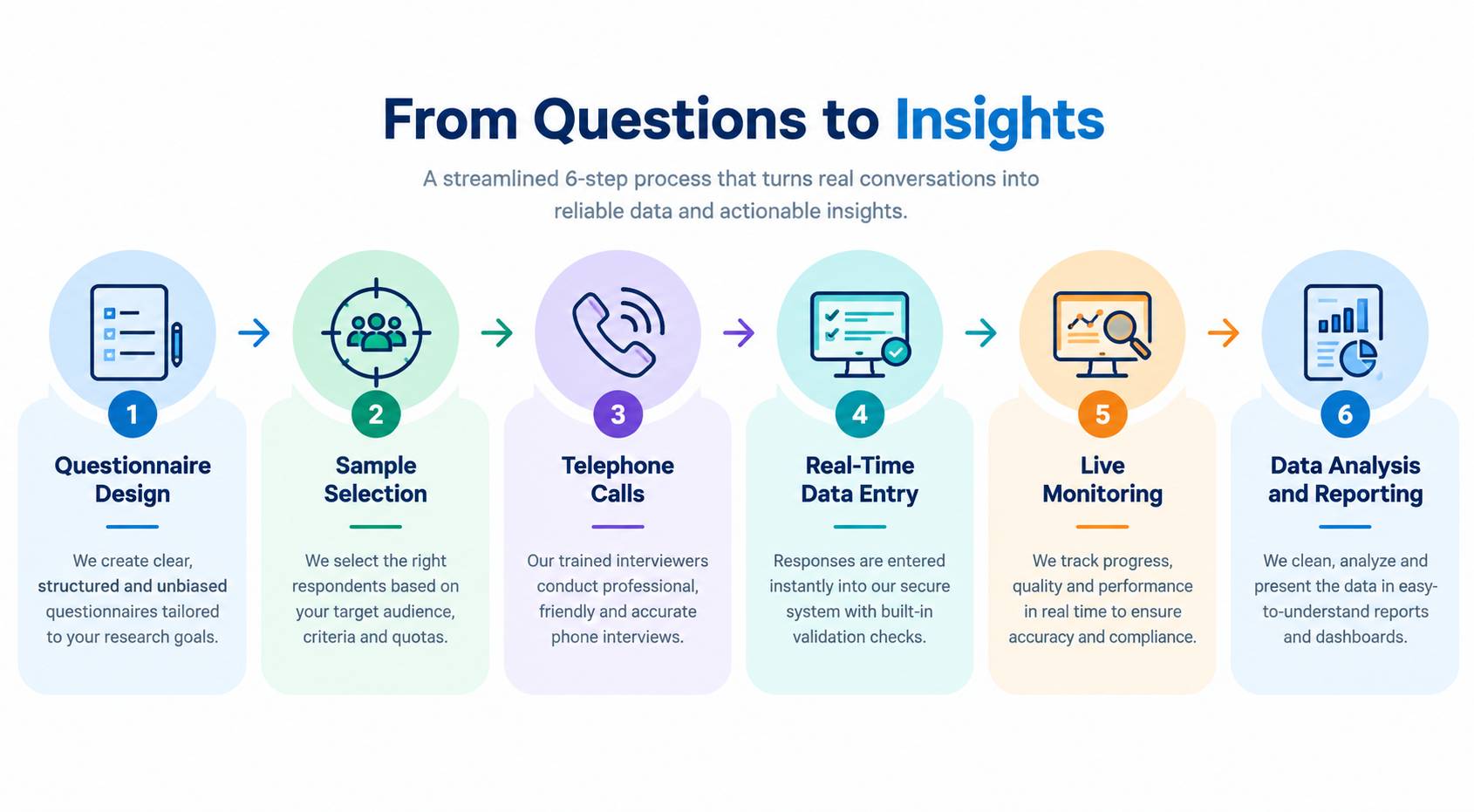
How Does CATI Work?
CATI is a structured process that runs through clearly defined
stages.
Questionnaire Design: Researchers build a
structured questionnaire based on the study's objectives. This
questionnaire is programmed into the CATI software along with all
routing rules, validation checks, and skip patterns.
Sample Selection: A representative sample is
selected based on the target audience. In India, this typically
means defining respondents by region, city tier, language group,
age, income level, or professional category, depending on what the
study requires.
Telephone Calls: Trained interviewers contact the
selected respondents. The CATI system displays each question on
the interviewer's screen in sequence, keeping the conversation
structured and consistent throughout.
Real-Time Data Entry: As the respondent answers,
the interviewer records responses directly into the system. There
is no paper, no lag, and no risk of data being lost or misread at
a later stage.
Live Monitoring: Supervisors can monitor
interviews as they happen, listen to calls for quality assurance,
and address any issue immediately. This level of oversight is
simply not possible with online surveys.
Data Analysis and Reporting: Once fieldwork is
complete, the data is ready for analysis almost immediately. There
is no separate data entry phase, which speeds up the entire
research timeline considerably.
CATI Survey in India: What Makes It Different Here
Running a CATI survey in India is not the same as running one in a
single-language, single-market environment. India's diversity
introduces specific considerations that every research team must
plan for from the very start.
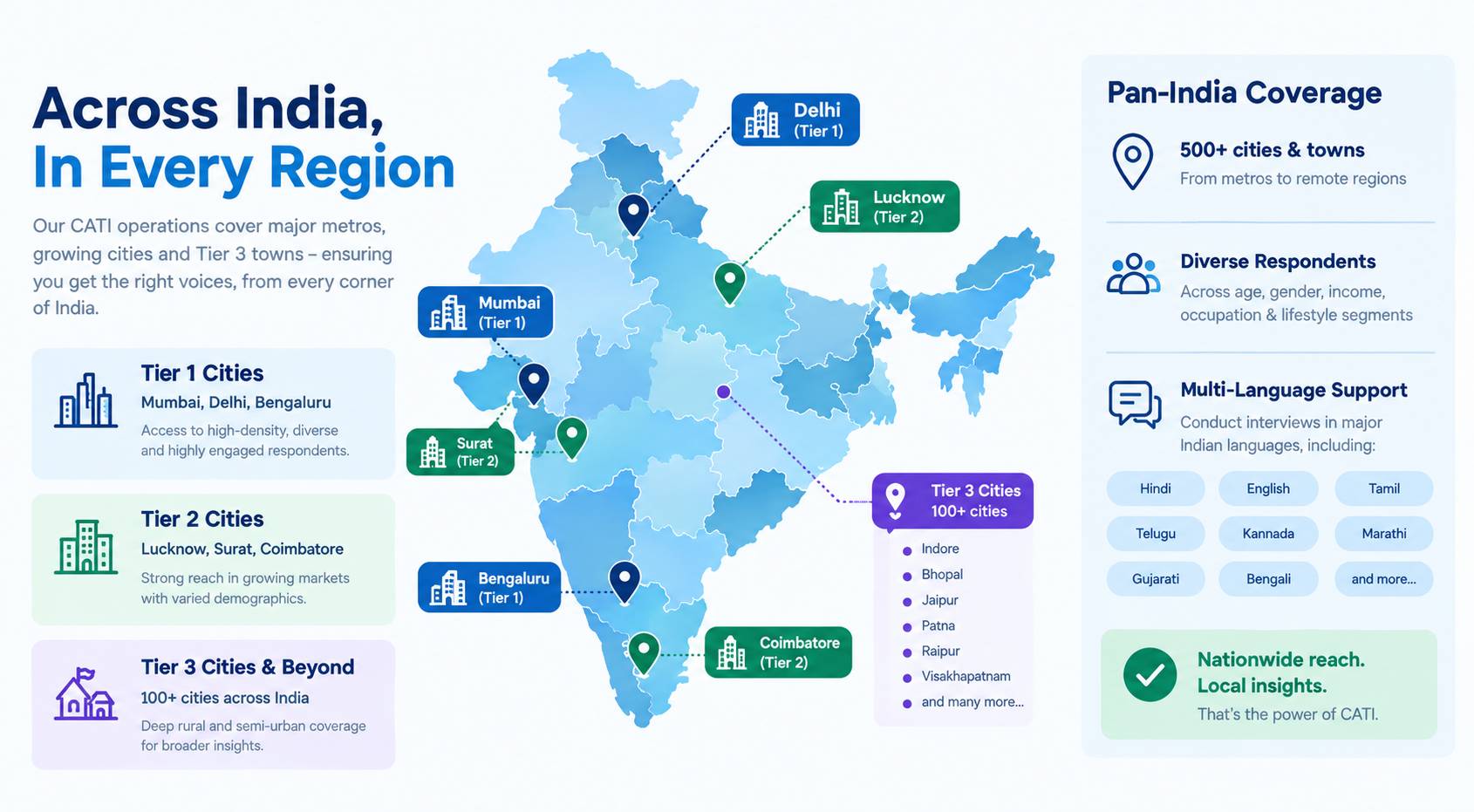
Language Coverage: India has 22 officially
recognised languages and hundreds of regional dialects. A
well-executed CATI survey in India requires interviewers who are
fluent in the relevant languages for each target geography,
covering Hindi, Tamil, Telugu, Bengali, Marathi, Kannada,
Gujarati, Malayalam, and more. Respondents interviewed in their
native language provide more complete and more accurate answers.
This is not a nice-to-have. It directly affects data quality.
Geographic Reach: CATI allows researchers to
reach respondents in Tier-1 cities like Mumbai, Delhi, and
Bengaluru, as well as Tier-2 and Tier-3 cities like Lucknow,
Coimbatore, Surat, and Bhopal. In areas where smartphone
penetration is low or internet connectivity is unreliable,
telephone-based research remains the most practical way to collect
representative data.
DND Compliance: India's Telecom Regulatory
Authority (TRAI) maintains a Do Not Disturb registry that
restricts outbound calls to registered numbers. Any CATI research
operation in India must screen its sample database against the DND
registry before fieldwork begins. Working with a research partner
who follows this requirement is essential for legal compliance and
for maintaining respondent trust.
Industries Using CATI Research in India: FMCG
companies use CATI for brand tracking and customer satisfaction
studies. Pharmaceutical companies conduct physician surveys and
patient feedback programmes. Telecom providers run CATI studies
for net promoter scoring and churn analysis. Banks and insurance
companies use it for customer experience research. Government and
policy organisations use CATI for large-scale public opinion
studies across states.
Advantages of CATI
Speed: With a team of trained interviewers and an
automated dialling system, a study with 1,000 respondents can be
completed within a matter of days. The data is ready for analysis
as soon as fieldwork ends.
Data Accuracy: The CATI software controls
routing, prevents invalid entries, and flags inconsistencies in
real time. This produces cleaner data from the outset and reduces
the time spent on post-fieldwork processing.
Interviewer Presence: A live interviewer can
clarify questions, manage respondent confusion, and probe for more
detailed answers when needed. This is particularly valuable for
complex B2B research, healthcare studies, and any topic where a
guided conversation makes a real difference to the quality of
responses collected.
Cost Efficiency: Compared to face-to-face
fieldwork across multiple states in India, CATI eliminates travel,
accommodation, and on-ground logistics. For nationwide studies,
the savings are significant without any compromise on data
quality.
Adaptability: CATI systems manage conditional
logic automatically, making them well-suited for segmentation
studies, multi-market research, and surveys with complex
eligibility criteria across different respondent profiles.
Challenges of CATI Survey Research
Although CATI surveys offer numerous benefits, there are some key
challenges that research teams need to plan for carefully.
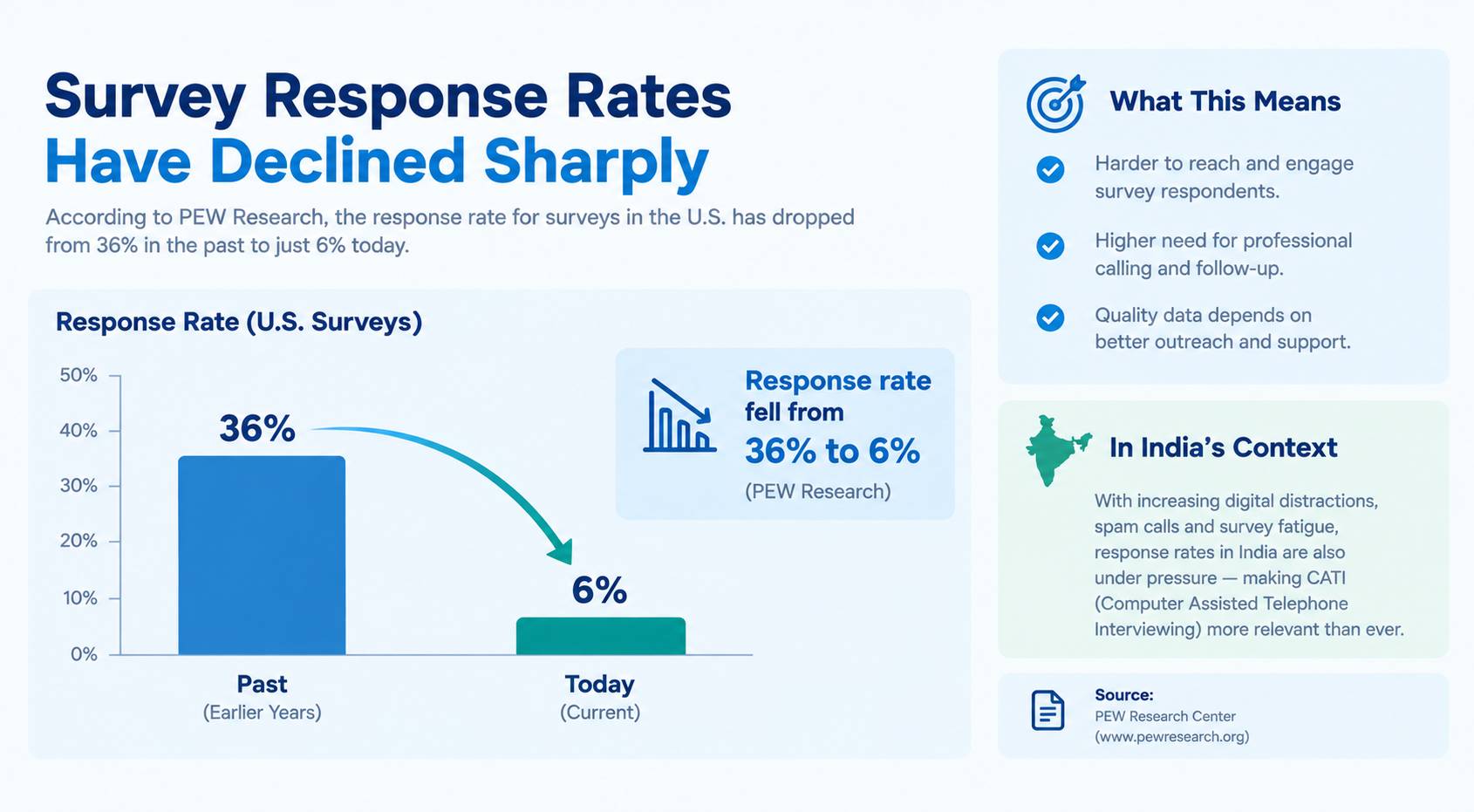
Declining Response Rates: According to studies
from the PEW Research Center, telephone survey response rates have
dropped significantly over the years, falling from 36% to
approximately 6%. In India, urban respondents are increasingly
cautious about picking up calls from unknown numbers, which
affects completion rates and requires higher call attempt volumes.
DND and Call Screening: India's DND registry and
the growing use of spam-filtering apps on smartphones create real
operational challenges for outbound CATI fieldwork. Research teams
need to account for this in sample planning and call scheduling
from the beginning.
Survey Length Constraints: CATI is most effective
for surveys that can be completed within 10 to 15 minutes. Longer
questionnaires increase respondent fatigue and drop-off rates.
Topics requiring extended exploration or visual materials are
better handled through face-to-face or online methods.
Interviewer Consistency: The quality of CATI data
depends heavily on well-trained, consistent interviewers.
Variations in tone or question delivery can introduce bias into
the data. Regular training, live monitoring, and back-check calls
help maintain high standards throughout the fieldwork period.
CATI Surveys vs Digital Surveys: What is the Difference?
CATI surveys are conducted over the phone by a trained interviewer
who reads questions and records responses through the CATI
software in real time. Digital surveys are self-administered by
respondents through email, social media, dedicated survey
platforms, in-app channels, or WhatsApp.
For research requiring wide geographic reach across India, a
respondent base that includes offline or low-digital populations,
or a high standard of data quality with real-time oversight, CATI
is typically the stronger choice. Digital surveys are more
cost-effective for reaching urban, educated, and digitally active
audiences at scale.
Many organisations in India now use a mixed-mode approach,
combining CATI for hard-to-reach populations with online methods
for digitally connected segments. This combination improves both
coverage and cost efficiency within a single research study. Both
methods have their place in a well-designed research programme.
The right choice depends on your target audience, your quality
requirements, and the nature of the questions you need to ask.
Frequently Asked Questions
What is a CATI survey used for in India?
+
CATI surveys are widely used in India for brand tracking, customer
satisfaction research, public opinion studies, healthcare surveys,
telecom feedback programmes, and B2B market research. They are
particularly valuable when a study requires multilingual fieldwork
or coverage across Tier-2 and Tier-3 cities.
How long does a CATI research project take in India?
+
Timelines depend on sample size, language requirements, and
questionnaire length. A study with 500 to 1,000 respondents
typically requires 5 to 10 business days for fieldwork. Analysis
and reporting timelines vary based on the scope of the
deliverables required.
How is data quality maintained in a CATI survey?
+
Quality is managed through real-time supervisor monitoring,
automated response validation built into the CATI software,
back-check calls to a sample of completed interviews, and
continuous interviewer performance tracking throughout the
fieldwork period.
Can CATI surveys cover regional languages across India?
+
Yes. A professional CATI operation supports all major Indian
languages. Coverage typically includes Hindi, Tamil, Telugu,
Kannada, Bengali, Marathi, Gujarati, and Malayalam, among others,
depending on the geographic scope of the study.
What is the ideal survey length for a CATI study?
+
The recommended length of interview for CATI is between 8 and 15
minutes. Studies within this range maintain respondent engagement
and produce higher completion rates. Anything beyond 15 minutes
should be evaluated carefully against the risk of increased
drop-off.